
Interactions Between Health and Retirement: Social Inequality Against the Backdrop of a Rise in the Retirement Age

Brief Information About the Project
Health is one of the most important determinants of the transition to retirement and of life chances after retirement. The relationship between health and retirement is not clear-cut due to opposing mechanisms: For example, both poor and good health can lead people to retire earlier or later. Consequently, the decision to retire cannot be explained solely by health status but is also influenced by other determinants of social inequality. However, changes in health during retirement must also be viewed in a nuanced way, as health limitations increase among some social groups, while health improves among others. In addition to these individual factors, macro-level influences must also be taken into account: In many European countries, including Germany, the age threshold for the standard old-age pension has been raised, which in turn can affect the health of (future) retirees.
These interactions between health, retirement, and socioeconomic status are the focus of the GeReAlt project. The project consists of two work packages being carried out at the University of Bamberg and at TU Dortmund University. Based on the Socio-Economic Panel (SOEP), the first work package examines (1) the determinants that, together with poor health, influence the timing of retirement, and (2) how health and well-being change in different socioeconomic groups after retirement. The second work package uses the Survey of Health, Ageing, and Retirement in Europe (SHARE) to examine whether raising the eligibility age for the standard old-age pension in European countries leads to a decline in health and well-being. The goal is to derive recommendations for action for policymakers, academia, and businesses based on the findings, which we will communicate through academic articles, policy papers, conferences, and a series of public events.
Selected Highlights from Meetings and Conferences
News from the Project
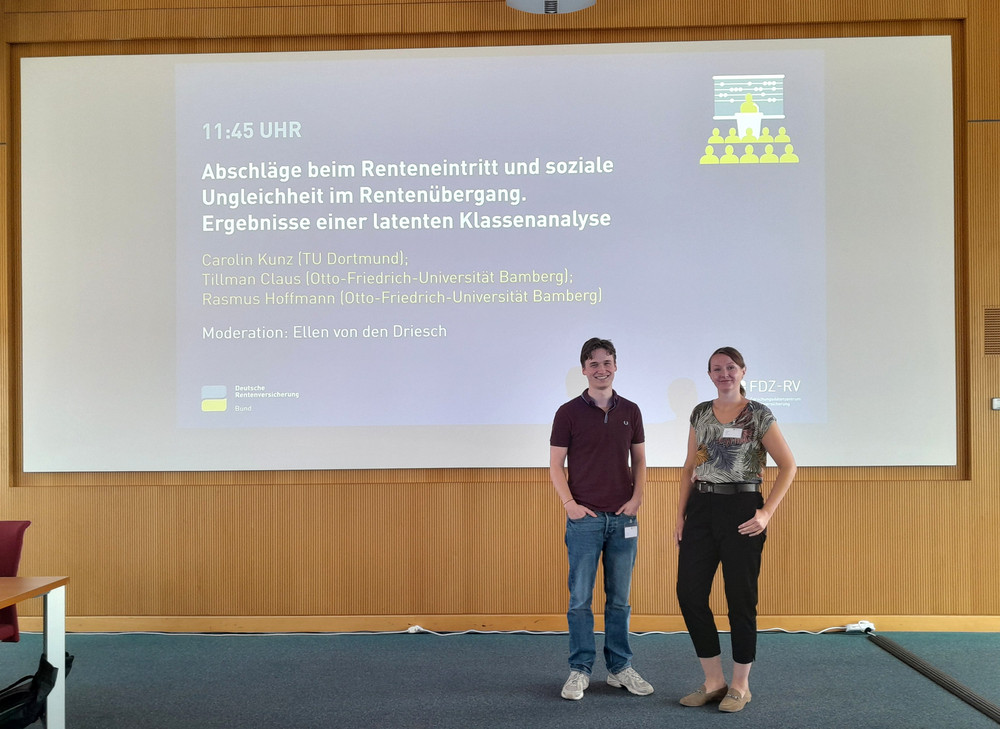
June 18, 2026 | Presentation: Dr. Carolin Kunz – “Pension Cuts at Retirement and Social Inequality in the Transition to Retirement: Results of a Latent Class Analysis”
Annual Conference of the Research Data Center for Pension Insurance (FDZ-RV)
July 1, 2026 | Presentation: Dr. Carolin Kunz – “Can Working Conditions Prevent Early Retirement of Informal Caregivers? Evidence from a Longitudinal Between–Within Analysis”
SLLS Annual Conference 2026, Brussels
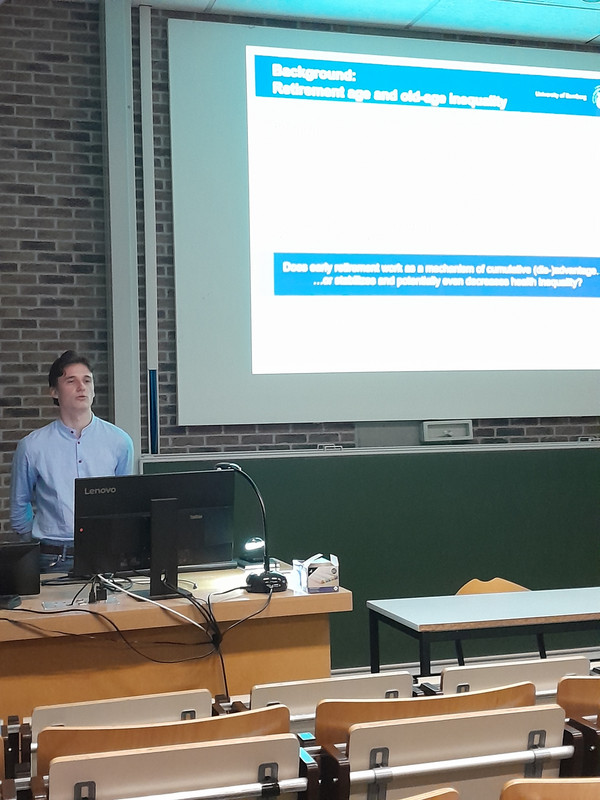
July 1, 2026 | Presentation: Tillman Claus – “The Health–Retirement Relationship as a Mechanism of Cumulative Inequality: A Systematic Review of Longitudinal Evidence”
SLLS Annual Conference 2026, Brussels
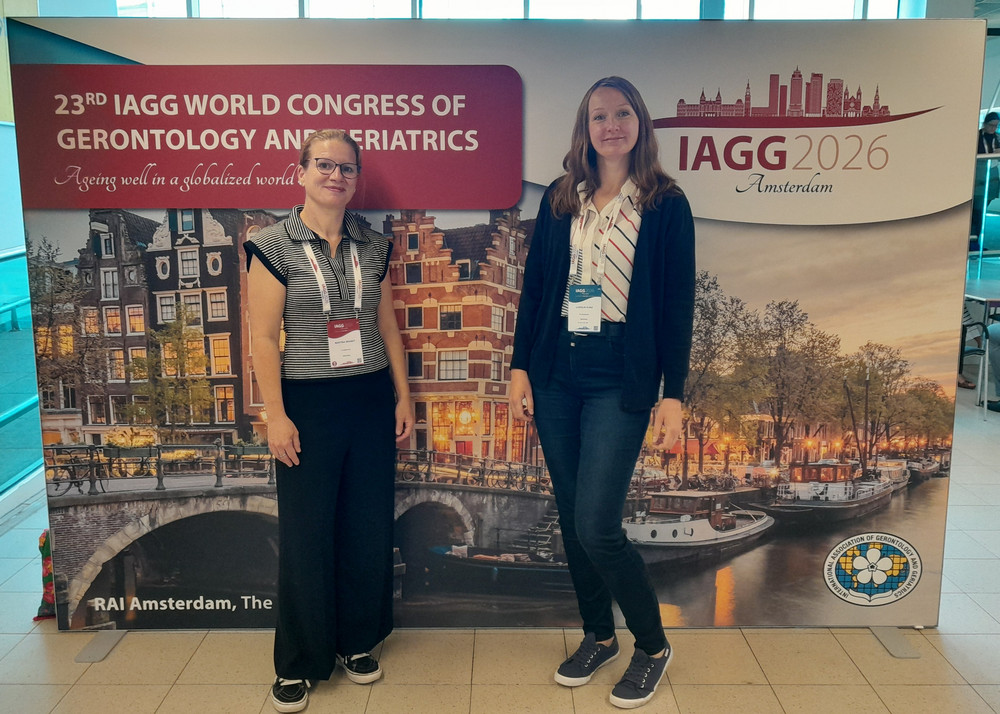
July 6, 2026 | Presentation: Dr. Carolin Kunz – “Can Working Conditions Prevent Early Retirement of Informal Caregivers? Evidence from a Longitudinal Between–Within Analysis”
23rd IAGG World Congress of Gerontology and Geriatrics, Amsterdam
October 6, 2026 | Workshop: “Determinants and Consequences of (Early) Retirement in the Context of Raising the Statutory Retirement Age”
Dortmund University of Technology
November 30, 2026 | Stakeholder Meeting: “Working Longer (in Good Health), Retiring in Good Health?” (in cooperation with the City of Dortmund’s Master Plan Science 2.0)
Projektor, Dortmund
Information About Employees
Behind the GeReAlt project is an interdisciplinary team that has been addressing issues related to aging, health, social inequality, and social policy for many years. The project team members are united by a shared interest in examining socially relevant issues using sound empirical methods and in contributing to the development of policy solutions.
Dortmund University of Technology
Prof. Dr. Martina Brandt
Professor of Social Structure and Sociology of Aging Societies at TU Dortmund University, Associate Dean for Research, and Spokesperson for the HBS Doctoral College “New Challenges in Aging Societies.” She also chaired the expert commission on the German federal government’s 9th Report on Aging and serves as “Area Coordinator for Family & Social Networks,” contributing to the central coordination of the Survey of Health, Aging, and Retirement in Europe (SHARE). In GeReAlt, she can contribute her expertise on the social situation of older adults and their living conditions to the analysis of pension policy and draw on her experience with the methods of empirical research on aging.
Dr. Carolin Kunz
Principal Investigator (PI) on the GeReAlt project; she also conducts research and teaches at the Chair of Social Structure and Sociology of Aging Societies at TU Dortmund University. As a sociologist of health, she focuses on the interplay between gainful employment, health, and transitions to retirement. By combining sociological theories with empirical analysis of SOEP and SHARE data, she aims to identify mechanisms underlying the interplay between health and retirement trajectories.
University of Bamberg
Prof. Dr. Rasmus Hoffmann
Professor of Sociology, specializing in social inequality, at the University of Bamberg. He serves on the executive board of the DGS Section on Medical and Health Sociology. His expertise lies in the fields of demography and life course research (particularly in old age), with a focus on the interaction between socioeconomic status and health. He has been conducting research on health inequalities in an international comparative context for many years and uses advanced quantitative methods to analyze complex relationships between socioeconomic status, health, and demographic trends. In the GeReAlt project, he contributes his methodological expertise in causal analysis as well as his substantive perspective on the role of structural inequalities in the aging process.
Tillman Claus
Ph.D. candidate in the project. Previously, during his master’s degree in sociology (M.Sc.) at the Catholic University of Leuven in Belgium, he focused on quantitative analysis and social data science. Since February 2025, he has been working as a research assistant on the GeReAlt project at the Chair of Sociology, with a focus on social inequality, at the University of Bamberg. There, he is investigating the effects of increases in the retirement age on social inequalities, particularly health inequalities, in Europe. As part of this project, he has begun his doctoral studies on the same topic at the Bamberg Graduate School of Social Sciences.
Further information:
About the University of Bamberg team: https://www.uni-bamberg.de/sozungleichheit/